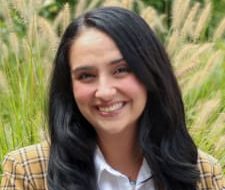
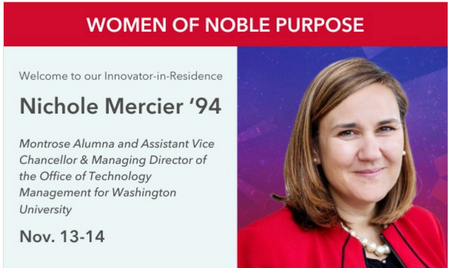
During her two-day residency, Dr. Nichole Mercier ’94 delivered talks across grade levels, met with faculty and administrators, and sat down with me for an extended interview. What emerged was a portrait of a scientist whose career spans biochemistry, commercialization, entrepreneurship and gender equity, yet someone who still exemplifies the Montrose virtues of character, perseverance and service, every single day.
Today, Dr. Mercier serves as the Vice Chancellor for Technology Management at Washington University in St. Louis, one of the nation’s leading research institutions. Her role centers on helping university discoveries become real-world products, navigating the intersection of science, business and social good. She is also the founder of Equalize Inc., a nonprofit that supports women scientists in bringing their innovations from the lab to the marketplace.
Although Montrose has changed dramatically since its Westwood campus days, Dr. Mercier immediately recognized the school’s constant and incredibly important purpose. “There’s so much more capacity now – the classes, the clubs, the opportunities,” she noted. “But the core of forming really good human beings and hard workers who will change the world – that’s the same.”
She recalled a class of 16 incredibly connected girls, students who became lifelong friends, and mentors, who helped her grow not just academically but personally. Teachers like Dr. Bohlin and Mrs. Cook, she said, “saw us as humans” and guided her through both strengths and struggles. That personalization, she explained, still influences how she leads today.
After graduating Montrose with five years of advanced math and science, Dr. Mercier entered Clark University with a scholarship and a plan to major in math. But college-level theoretical math felt far removed from the applied math she had loved at Montrose.
Instead of viewing that shift as failure, she recognized it as a sign she needed something different. Her journey eventually led her to biology, a PhD, and an unexpected realization: she did not enjoy the slow, repetitive pace of lab research. What she did love was seeing science actually reach people. That discovery led her to technology transfer, a field combining science, law, business, and human-centric innovation. Her message to students: academic and career paths rarely move in straight lines, and that’s perfectly normal!
“Sometimes the next right step isn’t a straight path,” she said. “And we have to be okay with that.”
At WashU, Dr. Mercier evaluates inventions from university labs and decides whether they should partner with existing companies or become startups. Part of that decision involves determining whether a technology is incremental, advanced, or disruptive, and understanding when a startup is the only way to keep a breakthrough from being shelved by industry competitors.
In founding her nonprofit, Equalize Inc., Dr. Mercier set out to address an unfortunate yet significant reality: only 11% of university-based startups are founded by women. Her nonprofit now spans 35 states and three countries, bringing together women from vastly different backgrounds but with a shared mission – gaining access to networks, language, and opportunities often closed to them.
She described Equalize as both a training ground and a community. Whether a scientist comes from a large research institution or a smaller university, many face the same barriers: unfamiliar business terminology, limited commercial networks, and the fear of asking questions in male-dominated rooms. Equalize fills those gaps by providing education, mentorship, and a peer community of women who understand one another’s experiences.
Montrose students were particularly struck by Dr. Mercier’s reflections on leadership. Emotional intelligence, she explained, is not about being emotional but about understanding what motivates people. “How I give feedback to one person is not the right way to give feedback to someone else,” she said. “If I know what helps each person give their best, then the whole team becomes stronger.” That emphasis on seeing people holistically, she added, is something she traces directly back to Montrose.
Long before her work in university innovation and entrepreneurship, Dr. Mercier spent college afternoons tutoring, coaching basketball, and mentoring children in Worcester. Those early experiences cultivated her commitment to using her skills in ways that serve others. “Service has always been core to who I am,” she reflected. “And Montrose absolutely nurtured that.”
For current Montrose students, Dr. Mercier’s visit offered a compelling model of how courage, curiosity, and a willingness to step into gaps can truly cultivate an incredibly inspiring career. Her story is not one of perfect certainty but of thoughtful pivots, resilience, and a genuine desire to see science reach the people who need it most!
And as she wrapped up her time on campus, the feeling among students was simple: we were grateful – not just for her advice – but for the clarity and confidence her journey gave us. Hearing from someone who once sat in Montrose classrooms made the promising possibilities ahead of us feel a little closer, and a lot more attainable.
By Sanya Nadeem ‘26, Editor-in-Chief and Politics Editor
26snadeem@montroseschool.org