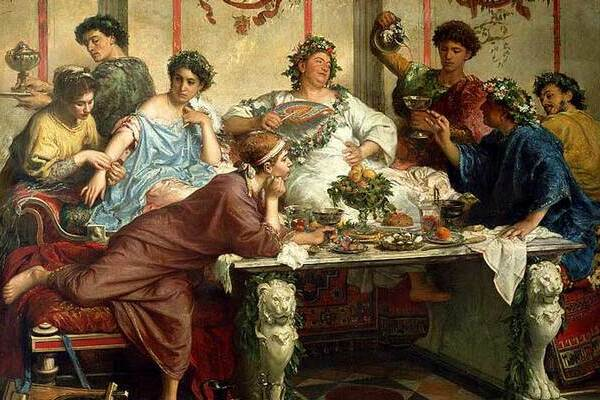
While Ancient Rome has several stark differences from our culture in the 21st century, there are several similarities that unite us to the past. One of the most similar ones is a Montrose favorite: food. Just like our Roman ancestors, we share the style of three main meals throughout the day, with one in the morning, afternoon and night. Just as we have breakfast, the Romans would enjoy ientaculum, which consisted of bread, fruit and cheese. Just like many today, ientaculum was designed to be light in order to be consumed before work and school, and it was even eaten as early as dawn. Ientaculum could also be picked up from vendors and bakeries and consumed on the go. After one’s ientculum, Romans would travel back home for their prandium, which was very similar to our lunch. Prandium was usually light food just like ientculum, and it often consisted of bread, vegetables and meat or fish. Prandium could be eaten as late as 3 p.m., and it would then be called merenda.
The last meal of the day was cena, and it was consumed in the later afternoon. Just as dinners now could be larger or private, so did the Romans have many different forms of eating. There were epulum, large public feasts, comissatio, a party for drinking, and private dinners for families, friends and clients. Cena occurred in the dining room, which was called the triclinium, due to the space consisting of three couches used for eating. It was on these couches that guests would recline, and they would share a small table in the middle for eating. The triclinium would often be adorned in mosaics, paintings and fixtures, and the utensils used for dining would often be silver. However, richer Romans would use more expensive materials for their meals, and they would even extend the number of courses in cena to show their wealth.
Unlike Ancient Greece, women were sometimes allowed to join men reclining on couches. Each couch could hold three people, and so a triclinium would contain nine guests in total. A typical cena possessed three mains courses: gustatio, which were similar to appetizers, mensae primae, an entree, and mensae secundae, which was similar to dessert. Dinner usually had an element of wheat in meals, and, therefore, it was common to have porridge. Romans would accompany this dish with cheese, nuts and honey to add flavor. However, richer men used cena in order to highlight their wealth, and, therefore, they used exotic animals and fruits to show their power. The most popular of these foods were pheasant, thrush, oysters, lobster, shellfish, venison, wild boar and peacock. Cena was also prized for its importance in entertainment, and it often contained musical performances, dances, poetry recitations and performances. Handsome staff would be chosen to serve guests for an additional visual, while other staff would sing as they served guests.
Food in Ancient Rome had many key features that are similar to our culture today. Just as the flavor of food was a symbol of status for many, so can the type of food you bring to school quickly make you popular. While there are no longer many musical performances in our meals, our own dinner can change from a private one with family, to one with colleagues, to even festivals with large groups of people! Rome is proof that in even a constant-fighting nation, people can still come together to enjoy the small aspects of life.
By Regina Maricich ‘29, Staff Writer
26rmaricich@montroseschool.org