School now is often considered to be the privileged bane of an adolescent’s life. For almost nine months, kids and teenagers have to wake up at six o’clock every five days, travel in all sorts of weather to school, and spend over seven hours bustling to each class, our backpacks and eyes growing increasingly heavier. Children in Ancient Rome faced a very similar plight, waking at dawn for school, punished physically for minor mistakes, and an education so tedious that eleven year old Quintus Sulpicius Maximus, died after training for a Greek poetry competition.
However, despite certain extremities of Classical education, there are several key similarities shared between our generation and the past, and many of which have shaped our education today.
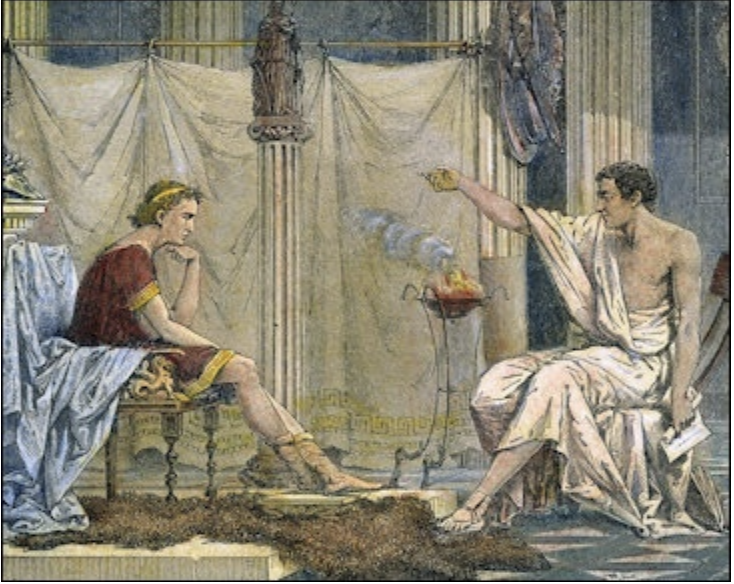
Unlike society today, there were no government funded public schools early in Roman history. Often, in a wealthy young scholar’s life, there would be a tutor, who educated the child privately, and taught them the alphabet, Greek, and reading. However, in poorer families, freemen (old slaves), would host school in small cramped buildings or outside, where pupils would crowd around their teacher, sit on a stool, and use their knees for a table. Due to the lack of established payment, a public teacher often lacked financial stability and was looked down upon by those with wealthier jobs.
Students in these schools would not use papyrus paper, which we use so exponentially now, but would rather have wooden tablets covered in wax, where students could then write in minuscule handwriting. Often each letter would be required to be less than a 0.5 inches, and could be condensed to writing as small as 0.19 inches!
Just as we have a primary school, the first step in Roman education was taught by a litterator, who educated the boys in writing the alphabet, discovering syllables, and eventually writing sentences. Exercises for sentence-writing were often copying down popular maxims, believed to help boys grow and form their character. Arithmetic was taught using pebbles for counting and later an abacus, with math tables often being memorized and chanted by an entire class.
Girls could also receive an education in their youth, however they would never quite move past primary school due to being married off very early in their life. Education for females also consisted of being taught the workings of the households and preparation to be a good-housewife.
Boys around nine to twelve years old would graduate from this ‘elementary school,’ and a few would move on to being taught by the grammaticus. Being educated at this stage usually required a firm foundation in reading and writing, which would then allow for boys to refine their skills as well as grow in oratory and Greek. A grammaticus’s curriculum mainly consisted of preparing boys who would eventually be taught by a rhetorician, and as a result boys were faced with exercises dealing with problems, understanding speeches, and learning about famous men. Astronomy, philosophy, and music were taught as well, and finally, around 15, when manhood was achieved, the boys would graduate.
Only a few would be educated by a rhetorician, and like college, would stay to be educated until one’s early twenties. The curriculum consisted of training men in public speaking, Roman law, literature, philosophy, geography, and other essential topics. The rhetoric would then give boys two oratory exercises, one called suasoria, and the other, controversia. Suasoria consisted of a speech given to an imaginary past character, such as Julius Caesar, in an attempt to persuade them to make a certain decision. Controversia, on the other hand, was a speech given by men that focused on following or making decisions pertaining to Roman law.
Just as doodles can be seen on notebooks, and eyes can drift to windows today, Romans too often created many means of distraction during school! Unlike us, there were no established weekends, with only a day off given after eight days of school, and a few weeks off for big festivals such as Saturnalia.
One common means of distraction would be the anointing of one’s eyes with oil. This, children realized, would give them an excuse to halt in writing for the day, as they could no longer see. However, despite the commonality of boredom in schools, teachers would often incentivize student perfection through physical beatings and harsh competition between pupils. Monotonous work would exhaust these students, often of whom never reached fifteen years old. Once, prodigy poet Quintus Maximus was pushed so hard by his parents that he eventually passed away after a Greek competition. A tomb was erected in his memory, and serves as a tragic reminder that despite Rome’s progressive, fascinating culture, there were still tutors struggling to eat, merchants and craftsmen barely literate, children beaten, and women trapped from receiving a proper education.
Sources:
https://factsanddetails.com/world/cat56/sub369/entry-6363.html