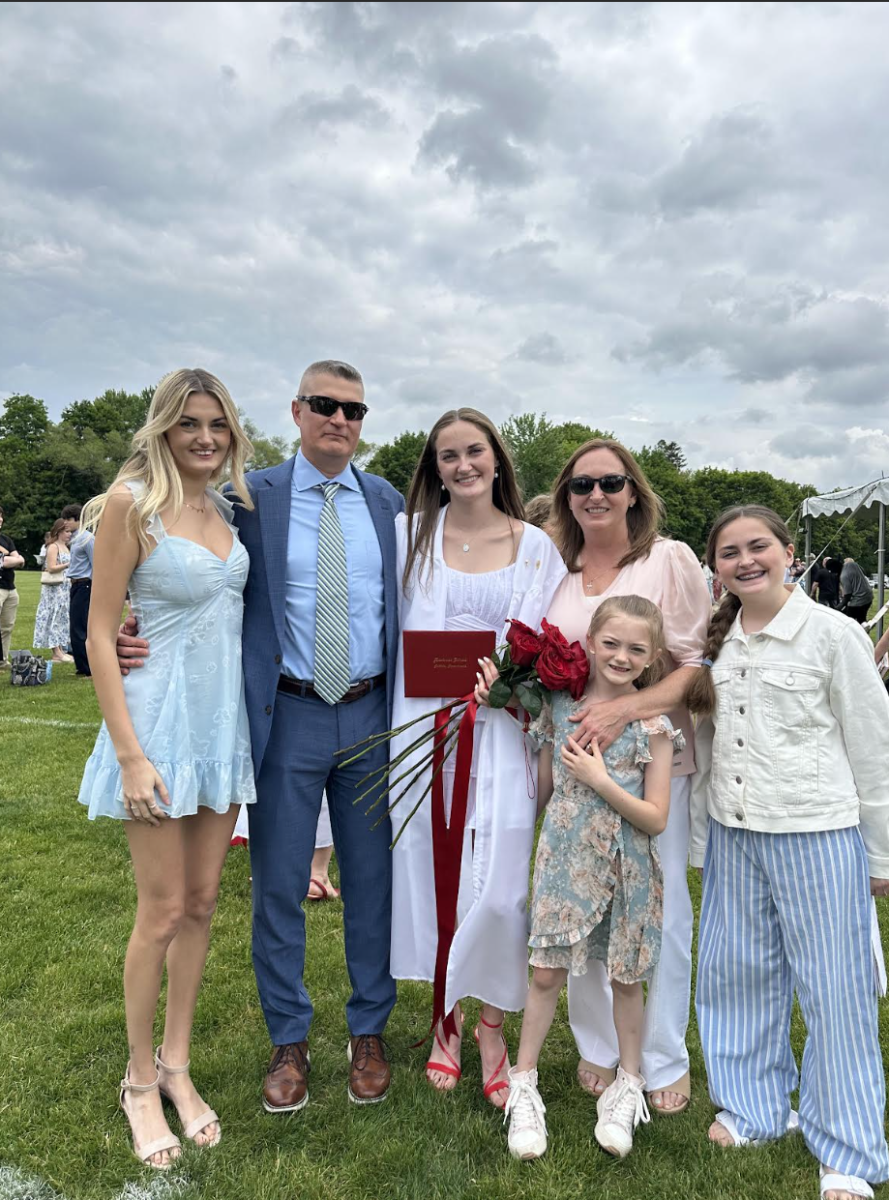
On Thursday, November 6, Montrose students gathered during CHR for a special Veterans Day presentation from Mr. Adam Beard – a U.S. Army veteran, longtime leader at Waters Corporation, and Montrose parent of Rosie Beard ’25 and Maggie Beard ’32.
In his talk, Mr. Beard offered Montrose students a rare, unfiltered look at what military service and combat truly demand, far beyond what Hollywood portrays. Blending personal stories with reflections on leadership, courage, and teamwork, he invited us to consider the real cost of service and the lessons it can hold for every person, whether or not they wear a uniform. His message was not only a tribute to those who have served, but a challenge for all of us to lead with integrity and purpose in our own lives, no matter what we choose to do!
About Mr. Beard:
Adam Beard is Vice President of Global Service at Waters Corporation in Milford, where he has worked since 2004. Prior to his career at Waters, Beard served eight years as an officer in the United States Army Air Cavalry, including service with the 82nd Airborne Division and the 3rd Infantry Division. In 2003, he led troops into Iraq as part of the first unit into the country during Operation Iraqi Freedom. Beard is a decorated combat veteran who was awarded the Bronze Star Medal for his combat service in Iraq. He also served as Commander of an Air Cavalry Troop and was Distinguished Honor Graduate from his U.S. Army Aviation Flight School class. Beard helped found and lead Waters Corporation’s Veterans Employee Resource Group and is a resident of Holliston, MA.
Mr Beard’s Montrose Veteran’s Day Address:
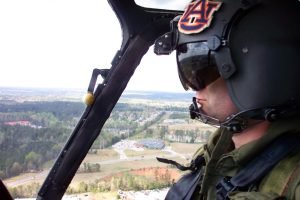
Good morning, and thank you for having me here today. My name is Adam Beard, and I’m a leader at Waters Corporation, a company based in Milford, MA. But before I worked at Waters, before I moved to Massachusetts, before I became a dad to four daughters – one of whom goes to school here with you – I spent eight years as an officer in the United States Army’s Cavalry.
I flew helicopters. I jumped out of airplanes with the 82nd Airborne Division. And in 2003, I led soldiers into combat in Iraq as part of the first unit into the country during the invasion.
Today, on Veterans Day, I want to share two things with you. First, I want to give you a window into what it’s actually like to be a soldier in combat – not the Hollywood version, but the real thing. And second, I want to talk about what that experience gave me, and what it might mean for you, even if you never serve in the military.
Before we dive in, I want you to know that some of what I’m going to share is intense. War is serious. People get hurt. But I think it’s important for you to understand what service members experience, and why we honor them on days like today.
So let me take you back to March 2003. Our unit – the 3rd Squadron, 7th Cavalry Regiment – was part of the tip of the spear pushing toward Baghdad. We had 500 vehicles in our convoy – tanks, Bradley fighting vehicles, Humvees, fuel trucks, everything we needed to fight and survive.
A journalist from USA Today named Sean Naylor was embedded with us, and he wrote about one particular 24-hour period that I’ll never forget. I’m going to walk you through his story, show you some photos from that time, and help you understand what it was really like.
This story starts on a Monday evening…
At this point in his presentation, Mr. Beard shared a 24-hour account of the 3/7 Cavalry’s advance toward Baghdad, originally reported by Sean Naylor in USA Today. Because the article is copyrighted, we are summarizing the events rather than reprinting them and only including Mr. Beard’s accounts. Mr. Beard combined Naylor’s reporting with his own memories from March 2003, offering students an inside look at the chaos, pressure, and split-second decisions soldiers faced during the early days of the Iraq War.
Mr. Beard Insert – Not from the original article by Naylor
I remember this radio call like it happened yesterday. The call came to me, my call sign was Saber 3A and in our usual Army radio protocol, Clay and I kept it simple and professional. The call sounded like this…
SABER 3A this is APACHE 6… APACHE 6 this is SABER 3A, “Go.”… 3A, APACHE 6 “We’re in contact, Over.” 6, 3A “Roger, Contact.” SABER 6 this is 3A, “Apache’s in contact.” 3A, 6, “Roger, Out.”
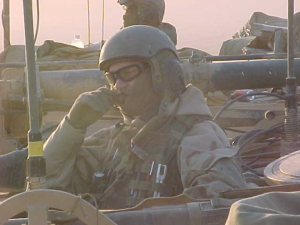
Since Warren Zinn was practically shooting the next images with his camera from right over my shoulder, I saw this unfold through the gun sights of my 7.62mm machine gun. The next images you will see are burned in my mind’s eye forever as I stood in over-watch protecting our dismounted troops while the situation unfolded.
So that’s what it was like. Twenty-four hours of chaos, confusion, split-second decisions, and somehow, miraculously, we all made it through.
When I came home from Iraq and eventually left the Army, people would sometimes ask me, “What was it like?” And honestly, that’s a hard question to answer. But over time, I realized there’s a better question: “What did it give you?”
Because the truth is, those experiences – not just that 24-hour period, but all eight years I spent in the Army – gave me things I use every single day. And here’s what I want you to understand: These aren’t just lessons for soldiers. They’re lessons for anyone who wants to lead, who wants to make a difference, who wants to do hard things.
Let me share three of them with you.
First, the military taught me that the best leaders empower the people closest to the action.
In that story I just told you, you heard me mention Captain Clay Lyle and Lieutenant Luke Devlin and all these other officers and soldiers making decisions in the moment. Our squadron commander, Lieutenant Colonel Ferrell, couldn’t possibly make every decision for 500 vehicles spread out over 15 miles in the dark while being ambushed. He had to trust his people.
In the Army, this is called “mission tactics.” You give people a clear vision of what needs to happen, you trust them to figure out how to make it happen, and you hold them accountable for results. When that bridge collapsed under Lieutenant Devlin’s tank, he didn’t wait for permission to figure out what to do next. He knew the mission – get to Baghdad – and he found a way to make it happen.
Here’s why this matters for you: You don’t have to wait for someone to tell you exactly what to do in every situation. When you understand the goal – whether that’s acing a group project, organizing an event, or helping your family – you have permission to figure out the best way to get there. The best leaders aren’t the ones who control everything. They’re the ones who empower others to act.
Second, the military taught me that diverse teams are stronger teams.
In my unit, I served alongside people from every part of this country and every background you can imagine. Rich kids and poor kids. People from cities and people from farms. Different races, different religions, different life experiences. Some had college degrees, some barely finished high school. And you know what? When we were in combat, none of those differences mattered.
What mattered was that we complemented each other’s strengths and covered each other’s weaknesses. The kid from rural Texas who grew up hunting could spot threats I’d never see. The soldier from New York City could navigate urban terrain better than anyone. The medic who saved that Iraqi family – he brought skills none of the rest of us had.
Here’s why this matters for you: The people who are different from you aren’t obstacles – they’re assets. When you’re working on a team, whether it’s in sports, in school, or someday at work, the best results come when you bring together people with different perspectives and different strengths. Resist the temptation to surround yourself with people who think like you. Seek out people who see things differently.
Third, the military taught me what real pressure feels like – and that I could handle it.
No amount of training prepared me for what I experienced in combat. The sounds, the smells, the fear, the weight of being responsible for other people’s lives – it was overwhelming. But here’s what I learned: You can do hard things. You can make decisions when you don’t have all the information. You can stay calm when everything around you is chaos. You can keep moving forward even when you’re scared.
Here’s why this matters for you: Whatever pressure you’re facing right now – a tough test, a difficult conversation, a big decision about your future – you’re more capable than you think. When I’m facing something hard in my life today, I remind myself: “I’ve been through worse. I can handle this.” And you can too. The challenges you face now are preparing you for bigger challenges later.
Those are three things the military gave me. But I’m sure you have questions – about the combat experience, about what it was really like, about how I dealt with it, about anything I’ve shared today. So I’m going to stop talking now and let you ask me whatever you want to know.
Thank you for your questions and for giving me your attention today. Before I go, I want to leave you with one final thought.
Veterans Day is about honoring people who served. But it’s also about recognizing that service takes many forms. Not everyone will serve in the military, and that’s okay. But all of you will have opportunities to serve – your families, your communities, your schools, your future workplaces, your country.
The lessons I learned in the Army – empowering others, working with diverse teams, staying calm under pressure – those aren’t just military lessons. They’re life lessons. And you’re learning versions of those same lessons right now, right here.
So, my challenge to you is this: Whatever you do with your life, lead. Empower the people around you. Seek out people who are different from you. And when things get hard – and they will get hard – remember that you’re more capable than you think.
Thank you, and happy Veterans Day.
Works Cited:
Naylor, Sean D. “Behind the Lines with the 3/7 Cav: Ambushes, Confusion, but Survival.” USA Today, 25 Mar. 2003.