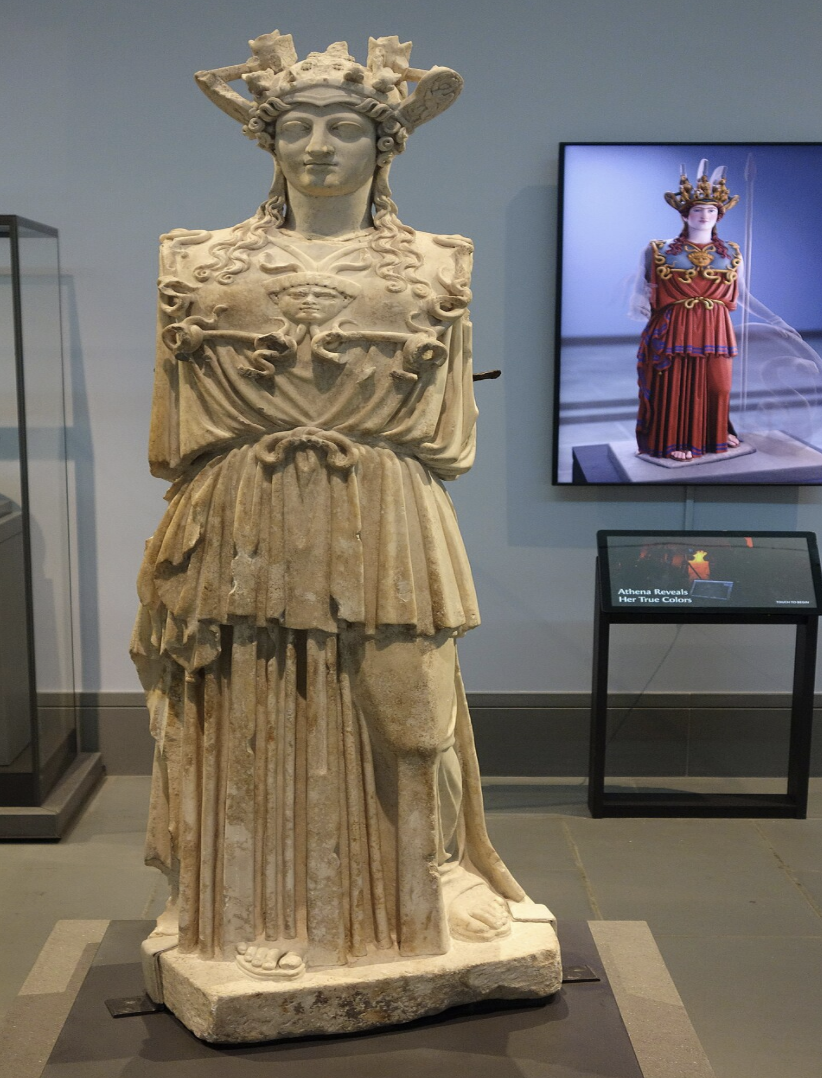
If someone were to mention ancient civilizations, many things may come immediately to someone’s mind. One may think about the Romans and their famous battles, the Greeks and their foundation of philosophy, of aqueducts, temples, and ancient ruins. But most of all, one might think of the defining characteristic which has been chosen to represent the classical world from textbooks, to museums, and especially in the media: white statues. White, hyperrealistic, Greek and Roman statues have defined the classical world for centuries, a key representation of intellect, nobility, and a reminder to everyone of a world that, while collapsed, still very much exists today.
However, often one’s ideas of history can be tainted by imagination, a lack of resources, and time, as it certainly is for the case of many ancient Roman and Greek aspects. And a most prominent example is the belief that the ancient people carved pure white statues. Contrary to belief, ancient statues were rarely painted white. Rather, statues, temples, and pottery were all depicted in an array of bright, vivid colors in a method called polychromy. But why then, is almost every single statue today in its pure marble form?
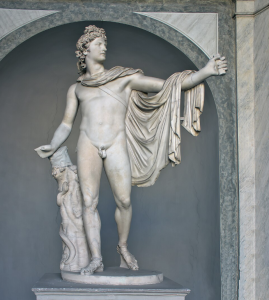
Greek and Roman art was lost for centuries before the time of the Renaissance, where a revival of Greek and Roman literature sparked a desire for the classics. Statues were recovered and admired, but by the time they were being rescued, time had weathered almost all of the paint until only a few pigmented spots could be visible. Seeing all of these statues of monochrome marble led people to believe that the ancient sculptors and artists purposely chose to abstain from paint in order to better highlight the movements and essence of their artwork. This was especially prevalent with the statue of Apollo discovered in 1498, whose movements were admired and whose pale marble offered a divine look.
The monochrome nature of ancient statues began a battle between artists during the Renaissance, centralized primarily on whether or not paint or pure marble should be used for sculptures. In a time where neo-platonist ideals were being revived, which primarily consisted of discovering the “ideas” or “essence” of things such as beauty, goodness, and justice through art and realistic depictions, these arguments were discussed and debated aggressively. However, in the end, an almost universal belief spread that monochrome, pure marble statues offered the most accessible way into discovering man’s true nature. Thus began the legacy of seeing and wanting to see statues in white. Artists mimicked their paradigm of ancient artwork, recreating pure marble temples and statues in their work. White became the sign of the classics, which in turn rose to the sign of purity, intelligence, and nobility.
However, this notion came into turbulence between the 18th and 19th centuries, when once more the ancient world was rewoken through neoclassical desires and beliefs. And so, just as before, more statues were rediscovered, but on some, there was more than just pure marble.
Around the late 18th century, the Artemis statue was recovered from Pompeii and brought to Naples. Unlike many of the statue’s predecessors, the Artemis’s polychromy had not completely faded, for on the statue were unmistakable traces of red.
Despite this, the first witness in 1760 of this recovered statue, Camillo Padneri, denied in his records the existence of any colors except for Artemis having blonde hair. But when Johann Joachim Winckelmann, an archaeologist and historian, also viewed this statue two years later, he did not hesitate to remark on the remains of color, yet attributed the statue as created by “Eutruscan” hands, rather than Roman ones.
This denial of polychromy by archaeologists or their attribution to the artwork as “primitive” is not surprising. For centuries, the world had viewed the ancients as clothed in white, painting in white, and building with white. Anything that was contradictory to those views was almost painful to convenience, and just as foreign and uncomfortable to digest as it is for us now. And it was exactly due to this awkward sense of change, ironically amidst a time of booming innovation, that continued this concept of white statues. But finally, around the 21st century, the paradigm began to shift as new technology rose.
Although some recovery of the statue’s true polychromy began around the late 18th century, the process was truly facilitated around the late 1900s. And by the 2000s, through use of technologies such as infrared and ultraviolet light as well as comparing the depictions faded statues against pieces of pottery or other better preserved ancient artworks, historians were now able to discover the remnants of pigments which were used and layered to create arrays of vibrant colors on statues.
In order to spread awareness of the truth about history, numerous plasters and 3D copies are being created of these ancient statues, where the statues are depicted in their hypothetical true appearance and displayed in exhibits all across the world. Technology now not only allows for these depictions to be more accurate, but also are safer to the statues themselves compared to the methods of rediscovering pigment centuries before, where pieces of the statue would be chipped and then tested with chemicals.
And the truth about polychromy not only goes for statues, but ancient temples as well! The ancient world was filled with resources for beautiful pigments, all of which once adorned these civilizations in an array of colors, which time has erased. But now as innovation progresses further, we are given a chance to truly see the narrative of the past as it was.
A threat, however, can prevent us from knowing the truth, not just with the instance of Greek and Roman statues, but for numerous other historical facts, stories, and objects, all of which possess some form that has been believed comfortably in our mind for centuries, but which could be questioned at any minute. Therefore, the truth of history does not just rely on the innovation of man, but of his open-mindedness as well. And hopefully, as time progresses, history can be resurfaced more and more, ruins rebuilt, statues repainted, stories retold, and ancient civilizations rediscovered.
Sources: