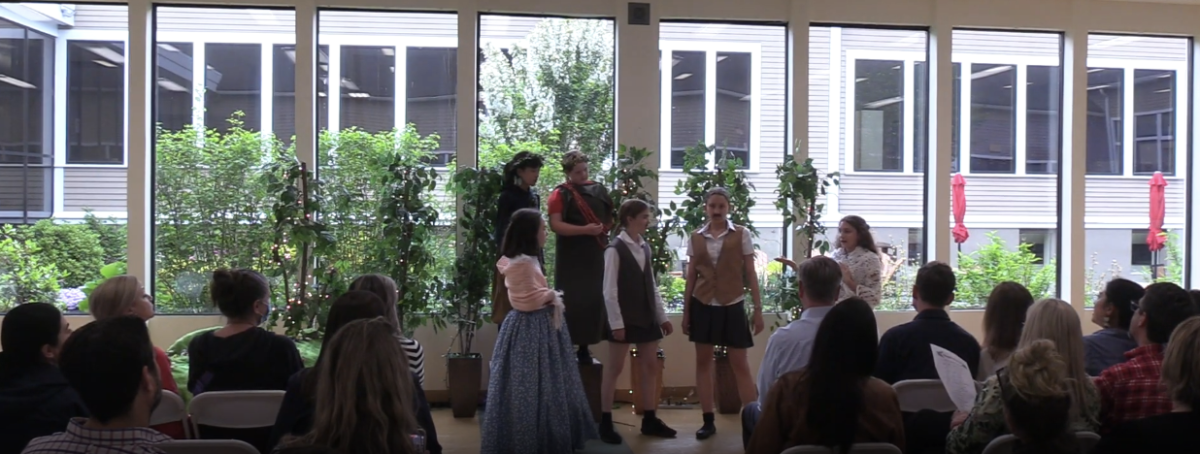
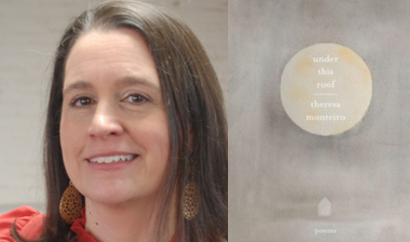
In honor of National Poetry Month, Montrose hosted Mrs. Theresa Monteiro as our Poet-in-Residence for April 15th and 16th. For these two days, Mrs. Monteiro met with English classes and both Middle and Upper School Creative Writing clubs to lead poetry reflections and writing exercises, culminating with an All-School presentation at Common Homeroom entitled “The Bravery of Paying Attention”. She also held a poetry reading, “Under the Roof of Heaven: Communion Through Imagination”, with selections from Under This Roof that was open to the public. This interview will combine sections from an interview I was privileged to have with Mrs. Monteiro and the experiences students had during her visit here.
Theresa Monteiro began writing poetry for the last decade, and has many publications in journals like the Black Fork Review and Poetry South, and her work was nominated for a Pushcart Prize. She currently has one volume of her poetry published by Fernwood Press in 2024, Under This Roof, and has a forthcoming volume planned.
—
Elisabeth Smith: …do you have a favorite poem from Under This Roof specifically? And why is that one your favorite?
Theresa Monteiro: I guess the poem that shares its title with the title of the book, “Under This Roof”, is one of my favorites. I don’t read it a lot in public because it’s so long, but it took a really long, long time to write. There were tons of revisions over a couple of years time. But it helped me think about the whole book. It was an anchor. So in that way it’s really special to me.
ES: What was the publishing process like for Under This Roof? How did you know that you were ready to get your poems published in the book?
TM: It was incredibly difficult. It’s one of the hardest things I’ve ever done. It was rejected so many times. I don’t want to tell you how many times it was rejected before Fernwood Press picked it up. People kept telling me, you know, you won’t get your book published unless you just keep pushing forward in spite of the rejections. And so it was just, over the course of a couple years, sending it out. And every time it was rejected, I would tweak it again. and reshape it. So it did change over time. …
ES: Would you say that your poetry writing is like a vocation or an avocation [hobby] for you?
TM: It feels like a vocation to me. You know, it feels as though… I think sometimes we think of vocation and we think, well, what is God calling me to do for the world and what impact is it going to make? But I try not to think about it that broadly. I just try to think God has called me to write, so I should write. And let’s let it unfold from there.
—
During her time at Montrose, Mrs. Monteiro worked with many English classes, Creative Writing, and Poetry clubs, sharing some of her own work as well as that of other poets, such as Gillian Clarke. She led varied writing exercises to help students overcome any hesitations about writing poetry and to get ideas on the paper. Using her metaphor, a sculptor can go to a quarry and find a block of marble to sculpt, but a poet has to make the marble themselves, and then sculpt it into something beautiful. The exercises Mrs. Monteiro facilitated for students aimed at helping them create their ‘block of marble’, or a basis for a poem they could develop later.
—
ES: What do you enjoy most about your time working here, at least in the past 2 days?
TM: The excitement and the enthusiasm of the students. I wasn’t expecting everyone to be so willing to try the things I was asking them to try. I wasn’t expecting to have so many questions, which I love. I love being asked questions. And that just made everything fun. When you’re trying to bring an exercise to someone and you’re trying to convince them they should try it, that can be exhausting, but it was just energizing.
ES: How do you think of poetry exercises? Are they just tips that you use naturally in making it out in a way that it’s accessible to others? Are they things that your teachers taught you?
TM: Yeah, there are things that my teachers have taught me. I think sometimes our brain can start on just living in autopilot. And I think exercises, writing exercises and poetry exercises kind of stop that autopilot cycling of the brain and ask it to sort of back up, turn around, find a new direction, opens up pathways to thinking about new poetry, new ideas. But we’re so busy all the time and there’s so much noise around us that if we don’t sort of jar the system a little bit, we can just keep running in those same cycles. So that’s why I love writing exercises.…
ES: Would you have any tips for students who feel like they’re stuck in writer’s block…?
TM: I mean, Google, Google writing exercises. You know, there’s so much online. It doesn’t really matter if it’s a good exercise or bad exercise if it gets you writing. Whenever I feel stuck, I try to write haiku for a while. They’re not necessarily counting syllables, but the small concentrated observation of the natural world and the human impact on it. I just try to write these tiny, tiny little poems that are 3 lines long and sometimes they grow into something bigger.
—
On the night of the 15th, Mrs. Monteiro held a poetry reading open to the public with selections from Under This Roof, including “The Prelude to Bach’s First Solo Cello Suite”, “On Martyrdom”, and the title poem, “Under This Roof”, among others. The reading was prefaced by a quote from the midcentury poet Elizabeth Bishop: “There is nothing more embarrassing than being a poet, really.” Many stereotypes about poets do circle about in modern society: the antisocial poet, the eccentric poet, the depressed poet, etc. However, Mrs. Monteiro makes it clear with her writing and demeanor that poets are not necessarily eccentric, and are often ordinary people writing about quotidian experiences, and that poetry is something, like singing, we can all do, regardless of skill.
—
ES: Is there a reason why you like sort of ordinary or mundane topics as a usual anchor for your poetry and not anything more spiritual or abstract to start with?
TM: I believe, I think, because I’ve spent so many years studying and living the teachings of Saint Josemaria… the founder of Opus Dei, that, it’s very natural for me to try to find the transcendent through the ordinary. And I’m also a stay- home mom… the whole content in my life is cleaning up spills and comforting a crying child, driving people around places and making dinner. And so if I don’t look for the transcendent and the spiritual in those ordinary things, I’m probably not going to find them.…
ES: Do you have… a favorite part about your work as a poet?
TM: I love the revision process. I love it when I have time to sit down and look at a draft and just cut things and move things, and I really, really love getting the opportunity to talk about my poems with my friends who are poets.
—
During our interview, Mrs. Monteiro shared some of her insights about the art of poetry and her own thoughts about her work, ranging from some of her favorite authors and inspiration.
—
ES: Do you have a favorite poem that you didn’t write?
TM: I have a few… I love Spring and Fall by Gerard Manley Hopkins. I love The Love Song of J. Alfred Poofrock by T. S. Elliot, The Circus Animals Desertion by W. B. Yeats. It depends on my mood. …
ES: How does religion and spirituality connect with your poetry too? Is it more an inspiration or a guide to reaching a different sort of end in your work?
TM: Well, I believe in this concept, the kind of unity of life… if we’re seeking God in all things, then we are seeking him in our work. We’re seeking him in our poetry. We’re seeking him in our family life. So I can’t really separate the two. So my poems come to me in prayer. And then sometimes when I’m struggling with a poem, I talk to God about it in prayer. How am I supposed to fix this? Because if it’s my vocation, then it shouldn’t be separated from the other things that I’m doing.
ES: How… are the poems that you hear when you are praying with God? Do they come about differently than poems that you think of when you’re not directly praying with God?
TM: Not really. They all come about sort of like they just float into my brain. I don’t know, or it depends on what’s going on in life and what things I’m observing. But, yeah, they just kind of grow. You feel the little seed of them in your brain and you start thinking about them and circling around them and they grow.
—
Although Theresa Monteiro could only visit Montrose for two days, her influence will last much longer. I have personally heard many students comment on the new ways they view poetry because of Mrs. Monteiro and the more modern poems she introduced to them. Before she parted from Montrose on the afternoon of April 16th, Mrs. Monteiro challenged students to pay attention in a world that so often lacks it, and to act upon what we are able to notice for the good of others as God calls us.
—
ES: …as our final question, if students could only remember one takeaway from your two days here, what would it be?
TM: I would say what I mentioned to them in this final talk, to keep paying attention, and when you find your vocation, continue pursuing it even when the enthusiasm fades. And I think if they do that with the spirit of prayer and a spirit of a love of God, then they’re just going to have a really great life. Yeah. It’ll probably have a lot of hardship in it too, because all life does, but I think that’s a good formula for making your way in the world.
—
So, on behalf of Montrose, I thank you, Mrs. Monteiro, for bringing your poetry, lessons, and inspiration to our community, and showing us to new ways to grow in our own writing. We are so appreciative of all of the love and attention you have given us, and we wish you all the best in your future.
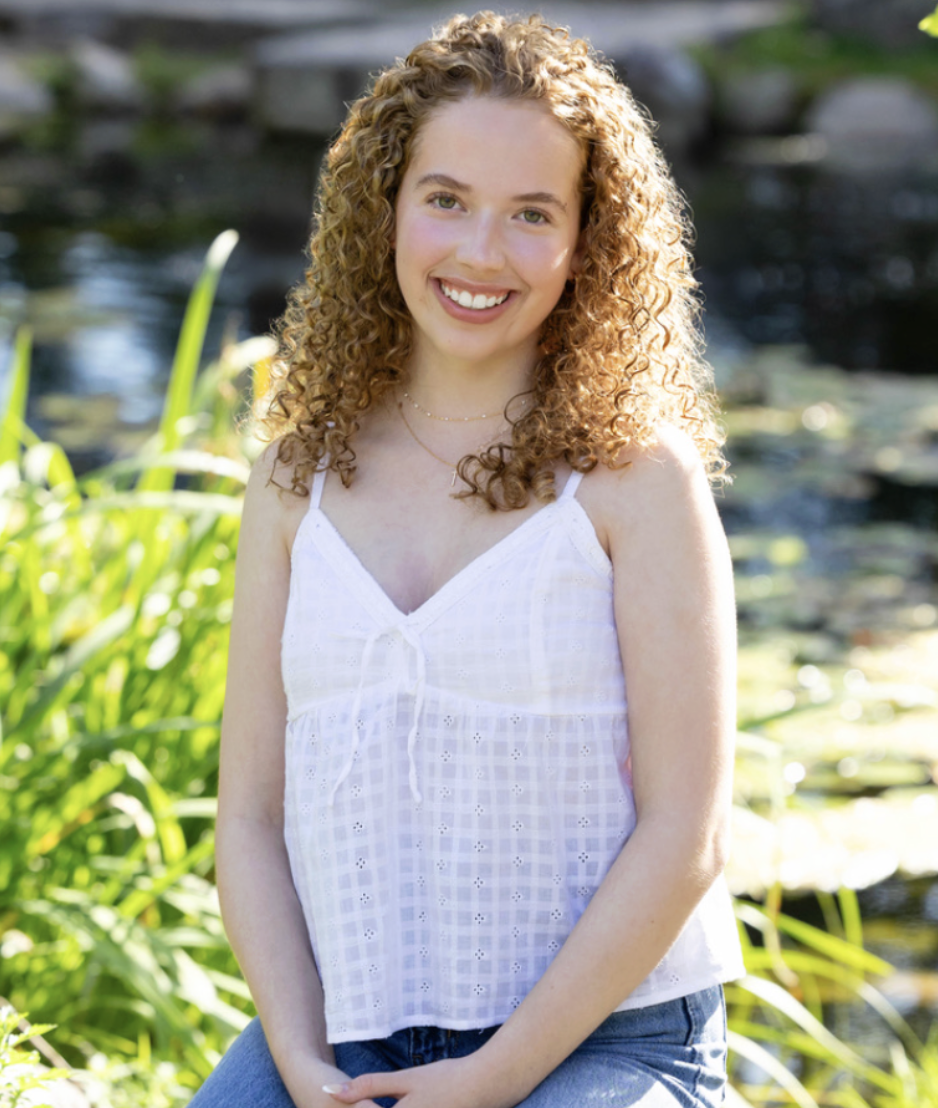
By Elisabeth Smith ’28, Co-Editor-in-Chief
28esmith@montroseschool.org