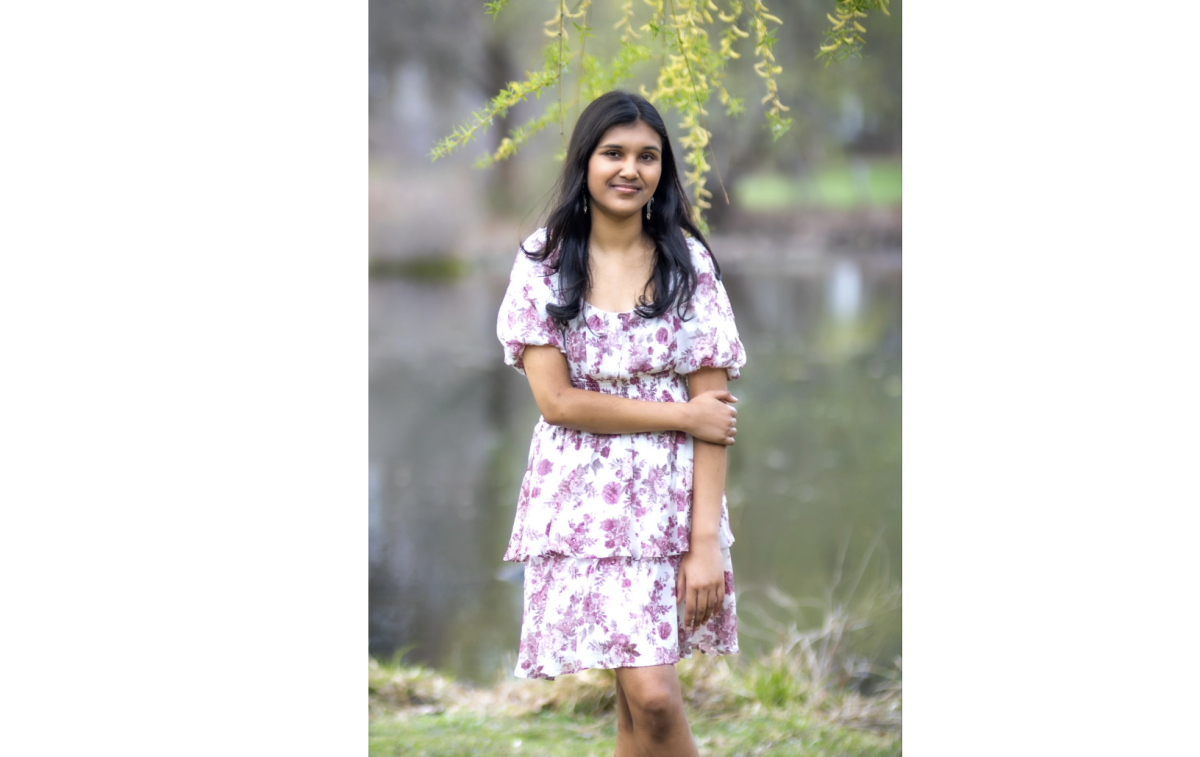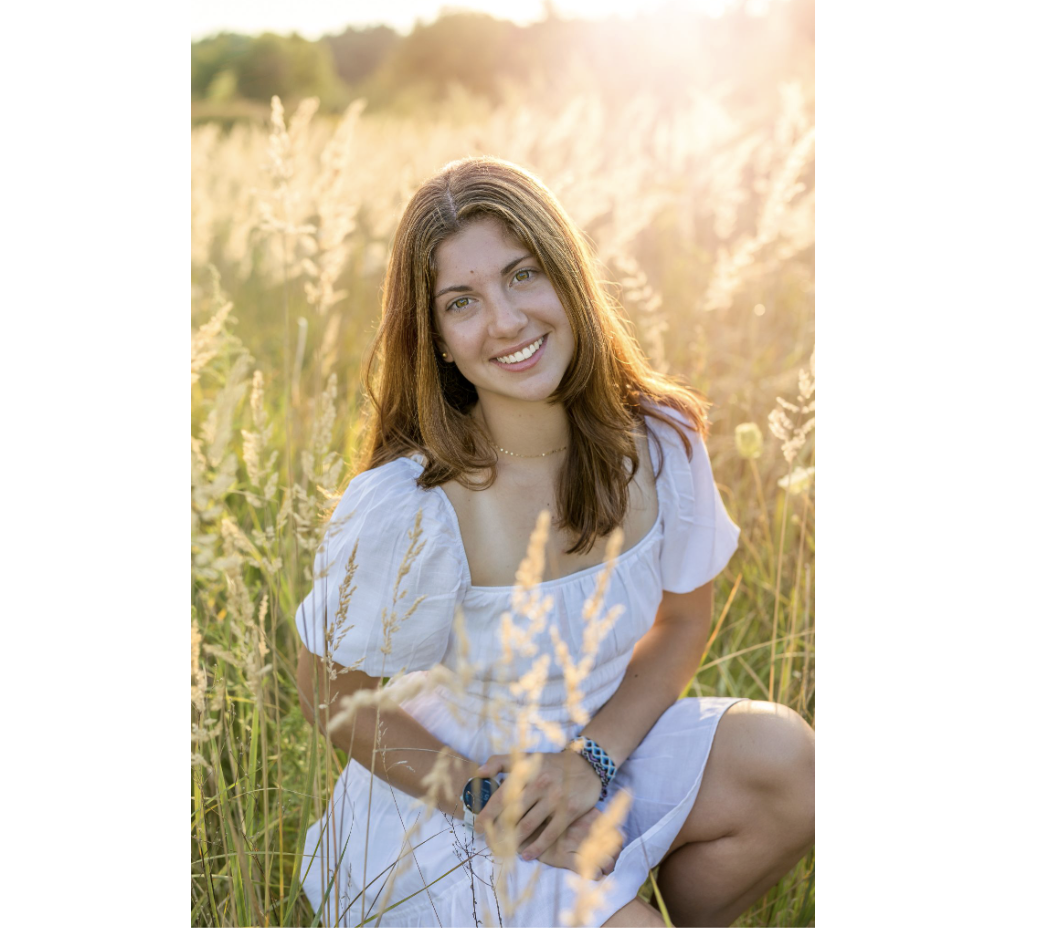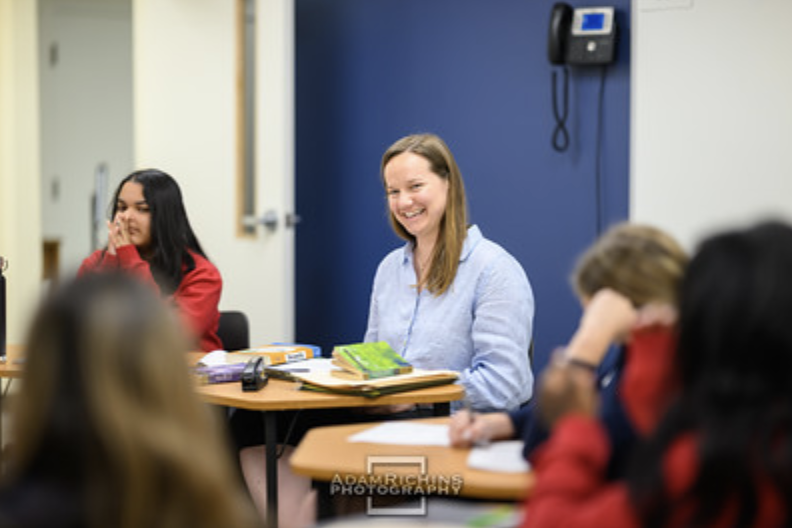
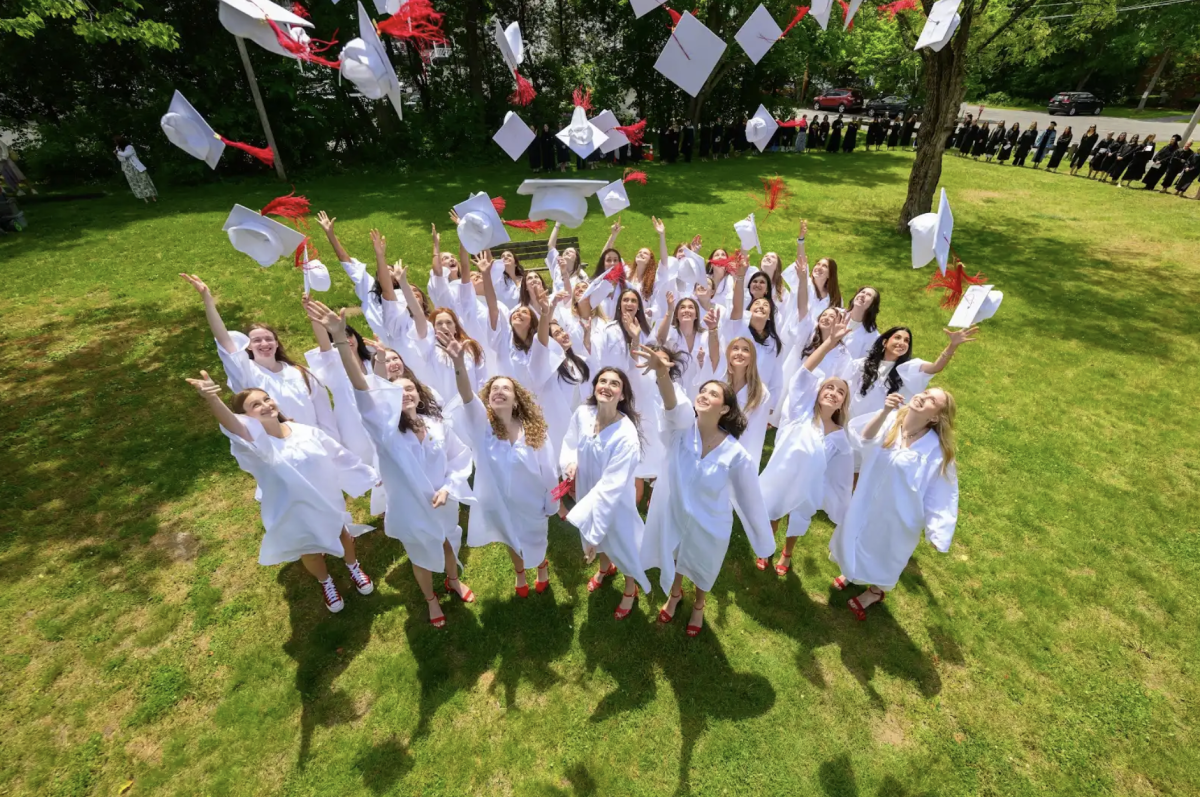
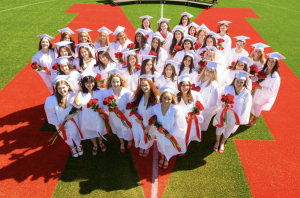
On the beautiful day of May 29th, the Montrose Community gathered under a tent on the field. However this time, it wasn’t on Miracle field, it was behind the First Parish Unitarian Universalist Church in Medfield (right across the street from Montrose), with a scenic pond and wildlife in the background. The Montrose Faculty, to the tune of “Pomp and Circumstance,” processed down the center aisle followed by the graduating Class of 2026. Then, the Treblemakers’ voices sailed throughout the tent, leading the gathering in singing the national Anthem.
Father John opened the ceremony with a blessing before Class of 2026 President, Maria Silveyra Dodds, emceed the event, first welcoming the crowd and then introducing Mr. Bill Noonan, the Chair of the Board of Trustees. In his address to the graduates, he expressed his gratitude toward the Montrose faculty and mentors for all of the care, commitment, and sense of purpose that they bring to the school. He also formally thanked all the parents for trusting and partnering with Montrose in the formation of their girls. He went on to tell the graduates that it’s the small things done for God that make the biggest difference – a theme that was built on throughout the ceremony.
Next Mrs. Elrod addressed the graduates with many words of admiration and thankfulness. She spoke of how the Montrose logo with the three Latin words Veritas, Caritas, and Libertas encompasses how the world needs these graduates, saying: Veritas: “the World needs your great mind,” Caritas: “the World needs your heart,” and Libertas: “the world needs your character.”
In step with tradition, graduation ceremonies also serve as an opportunity to honor teachers of great service to the school. This year at the 45th Commencement exercises, art teacher Christina Marge was honored for her 20 years at Montrose School. Assistant Head of School Mrs. Roberts gave a touching tribute that highlighted the way that Mrs. Marge brings beauty to everything that she touches. Mrs. Marge received a well deserved standing ovation from the crowd.
Next, Kendra Baker, the Saluditorian, took the audience down memory lane. Starting with her 6th grade Vermont trip where her Montrose career started, she highlighted moments that brought the class together such as the Covid pandemic, freshmen NHD projects, the Dominican Republic service trip, playing card games and getting sunburned. She used an analogy of the Senior Commons to represent the class of 2026. There’s always someone there, and that’s what brings them together: they are always there for one another. They might be a messy class, but they are a sisterhood that sticks together, and she told her fellow graduates that the strength of their class is that they will always have smart, dedicated, and kind people to go to. She left the class with five things to always remember: first, that you really are unique and unrepeatable; second, that we are always only a call or text away; third, don’t forget your memories of Montrose, fourth, that service is truly important; and finally, have fun at college and “stay lit!”
Giving a final address before the diplomas were awarded, speaker Dr. Jennifer Driver, who specializes in geriatrics and oncology and spearheads intervention programs through the Veterans Administration, shared with the Class of 2026 her insights and advice as they move forward in the world. Dr. Driver opened her talk by sharing the results of a survey given to the seniors about what they valued most in life: their relationships with family, friends, and God. These were the same answers she received with veterans with whom she works—meaning that the seniors already have their life priorities straight. With anecdotes from her own life, Dr. Driver reminded the seniors that connection with and caring for others is what truly matters, and that they should live these out far beyond Montrose’s campus. She reminded them also of the research on church attendance and correlations of happiness, based on research from Harvard’s Human Flourishing Project.
What followed was Mrs. Elrod sharing tributes about each individual senior—like final love letters from the faculty and mentors—showing that each is known and loved. After the diplomas were awarded and senior tributes given, Valedictorian Carolina Florez spoke to the Class of 2026 one last time. Carolina shared that the world really needs all of the little ways her classmates have worked hard and cared for each other and the common good. She encouraged her classmates to continue asking hard questions because she said “meaningful progress occurs when people question.” She drew on Aristotle’s idea that we are what we repeatedly do in order to tell the seniors that their character is built quietly in each faithful small moment. She told her fellow seniors to question the world and care for those in it. She left them with these final words of wisdom: Changing the world is not done in the big courageous moments; it is changed in all the small acts of kindness.
Father John closed the ceremony with a beautiful blessing, after which the graduates processed out of the tent and into the open grass in order to say goodbye to their teachers and greet their families. A long line of hugs through the faculty receiving line followed.
Congratulations to the Class of 2026! We are so proud of everything you have accomplished and contributed to our school, and we wish you all the best in whatever you do next!
Valedictorian Address by Carolina Florez ‘26
Good morning Mrs. Elrod, faculty, staff, parents, guests, students, and, most importantly, graduates!
To my class, congratulations! All of our hard work has culminated in this momentous occasion.
As I’m sure the Latin scholars in my class know, the word “Valedictorian” comes from the Latin words “vale” and “dicere”, which together mean “the one who says farewell”. I am definitely not ready to say goodbye just yet so I’m stretching this speech out as long as I can. Just kidding, everyone just got a terrified look on their face, but the purpose of this speech is really to say farewell and send you all into the world with a meaningful message – no pressure at all though.
One of the things that made our class memorable was that we were never afraid to ask questions. As I’m sure our teachers can attest – especially Mrs. Maricich – we constantly challenged ideas, debated policies, and questioned why things were done a certain way. At times, this may have led to restorative justices, but over time I realized that this instinct to question, to challenge, and to refuse to blindly accept things simply because “that’s how they’ve always been” became one of the defining characteristics of our class. Whether we were asking to add live grading, change Wednesday afternoon enrichment, or berating Father John with questions about Adam and Eve, we refused to stop thinking critically.
The world needs people willing to think critically and challenge systems that no longer work. We read Letter from a Birmingham Jail amidst the peak of our senioritis, so let me give everyone a refresher. Martin Luther King Jr. argued that progress only happens when people are willing to question injustice rather than passively accept it. Obviously, debates over school policy and the Civil Rights Movement are very different things, but the principle remains the same: meaningful progress begins when people care enough to ask difficult questions. I hope that as we leave Montrose, we continue to carry that spirit with us. I hope we continue to question assumptions, challenge limits, and refuse to settle for complacency.
But I also hope we remember something equally important: change is not created through defiance alone.
We spent a LOT of time studying Aristotle with Dr. Sullivan—arguably more time than Aristotle spent writing his own works, and one of the most important things he wrote, in my humble opinion, is, “We are what we repeatedly do. Excellence, then, is not an act, but a habit.” The older I get, the more I realize how true that is. Who we become is defined by our small choices rather than the dramatic moments. Our character is built quietly. Similarly, change is built quietly.
Looking back, what made Montrose special was not only the big moments like prom, field day, or IGC championship games. It was the quieter moments: playing cards in the senior commons, floor hockey in freshman PE, laughing behind the sophomore lockers, and consistently showing up for one another. Those moments that may have seemed insignificant slowly built a community. And that is what I think our class did best. Beneath all the over-caffeinated chaos, there was genuine engagement. We cared enough to participate, to challenge ideas, and to invest ourselves in the people around us. That balance – between questioning the world and caring for the people in it – is something worth holding onto.
Author Arthur Brooks writes that divided communities are not healed through one incredible speech or grand gesture. They are changed through small, repeated acts: listening before responding, treating people with dignity, and choosing connection over division. In other words, progress is built not only through big moments of courage, but also through small acts of kindness.
That lesson feels especially important for people like us. We are ambitious, passionate, and driven. We want to make an impact on the world. But lasting impact is not only made through disruption – it is made through connection. The future needs people who can challenge broken systems, but it also needs people who can build bridges between others.
Years from now, most of us probably won’t remember the grade we got on an AP Lang essay or our Capstone Q&A score. We will remember who challenged us to think differently, who supported us during difficult moments, and who showed kindness when it mattered most. Our lives after Montrose will work the same way. Our impact on the world will not come from one defining moment. It will come from the small things we repeatedly choose to do: the courage to ask hard questions, the willingness to listen, and the decision to build community rather than division.
So as we leave this community of 200-plus girls and head into a much bigger world – where, unfortunately, playing musical chairs is no longer socially acceptable – I hope we keep the pioneering spirit that made our class impossible to forget. I hope we continue to question limits and challenge assumptions. But I also hope we remember that the most meaningful change often begins quietly: in habits, conversations, and small acts of kindness repeated over time.
Saluditorian Address by Kendra Baker ‘26
Good morning Montrose faculty, staff, friends and family, special guests, and most importantly; my friends and sisters, the class of 2026. My name is Kendra Baker and I am honored to be able to address all of you today as the salutatorian.
As I look at my fellow graduates, I see not only bright futures in the familiar faces who have become my family over the past seven years, but I also see memories of laughter, smiles, tears, and to be honest, a whole lot of food. And I love being nostalgic, so, please bear with me while we take a trip down memory lane.
We start in 6th grade, well, technically, before 6th grade, on the inaugural Vermont trip. Our first bonding experience as a grade happened that first night on the trip because of a certain someone sleeptalking about “passing her the pink boot”, which to this day, none of us own pink boots yet our late night giggles about it drove Mrs Melly crazy. Sorry about that one Mrs Melly…
But from that moment, our class bond was starting to form and it only grew throughout middle school. We went through covid together, experienced a weird obsession with Atticus Finch, participated in the locker room incident– if you know you know– and if not, well, let’s just say there is a reason that the locker room is always locked. There was also that unfortunate incident in badminton. And as our class grew in size over time, we also grew closer together.
Freshman year truly was our most formative year. We were almost complete, only missing 4 of the people you are celebrating today, and under the guidance of Mrs Whitlock with the theme of courageous conversations, we grew closer than we ever had been before, even going as far to travel to Level 99 to test our friendships. But nothing really tested us like our first experience of what seemed like the biggest thing in the world: National History Day and all of the late night questions that came with it in our class group chat, which did not have the iconic name it does now, that came sophomore year. And what really was the biggest thing in the world at the time, getting tickets for the era’s tour! It didn’t matter what class we were in when those tickets dropped, we were on ticketmaster, but honestly, our teachers probably were too.
Our sophomore and junior years were marked by AP’s, sitting behind the lockers, and really solidifying our reputation around food. Shout out to Father John for rescuing Annie’s doordash so it didn’t get confiscated. And the stress of APs and the looming giant of college apps definitely bonded us so sorry to Mrs Maricich for having to deal with how that stress presented itself. Our first service trip to the Dominican Republic united different groups of us, not the way senior year did, but intense card games and getting violently sunburnt certainly made the groups closer. The beginning of our transition to our final year of high school really brought the whole grade together.
Senior year was my favorite year at Montrose, and the year that all of us really put aside any differences or drama to become the family I cherish so much. Not only that, but it was also the year I could see so much growth on both the individual level and a group level. From our matching sweatshirts to our continued support for each other through the college process, our friendships were clearly strong. Between playing card games like president or pollo, – which got entirely too intense – decorating grad caps at senior sleepover, chipotle runs every day of the week, and having our final full circle moment watching senior skits, Senior year made us closer than ever before.
The senior commons and the state of it, really represents our grade and our friendships. Obviously, physically, we were all there and all of our stuff lived there, but also, the commons represented our strength as a class. Although it was not always the neatest, or cleanest, it always had people in it, maybe a group of friends studying, or playing cards, or just hanging out and chatting. Now, all these memories might make it seem like we have always been a big group of best friends, but much like any family, we have had our ups and downs. Like the senior commons, we’re a bit of a messy grade, we’ve gotten in trouble, we’ve had drama, but at the end of the day, I know this group of girls will go on to do incredible things and that we will always have a collection of smart, dedicated, and kind people to go to whenever we need someone to laugh with, cry with, or anything in between.
And I hope that when you guys see a deck of cards, a table of desserts, or a late slip, you will think of our grade and all of the other wonderful memories we have had together. I know that each and everyone of you has a bright future ahead of you so I’m just going to leave you with five things I think are important to remember.
First: You really are all unique and unrepeatable so let me be (hopefully) the last to remind you all of that.
Second: Never ever ever hesitate to call or text any of us with anything. Well, at least don’t hesitate to call me because I will definitely be getting a little homesick for New England.
Third: don’t forget all of the amazing memories and lessons we have learned here because they really have made us who we are today. We truly did know how to have fun.
Fourth: Service is important, Montrose made it easy to get involved, now it’s up to you to choose to stay involved in it.
And finally, just for my sisters: have fun in college, stay lit, and never EVER end on a 2. Love you guys.