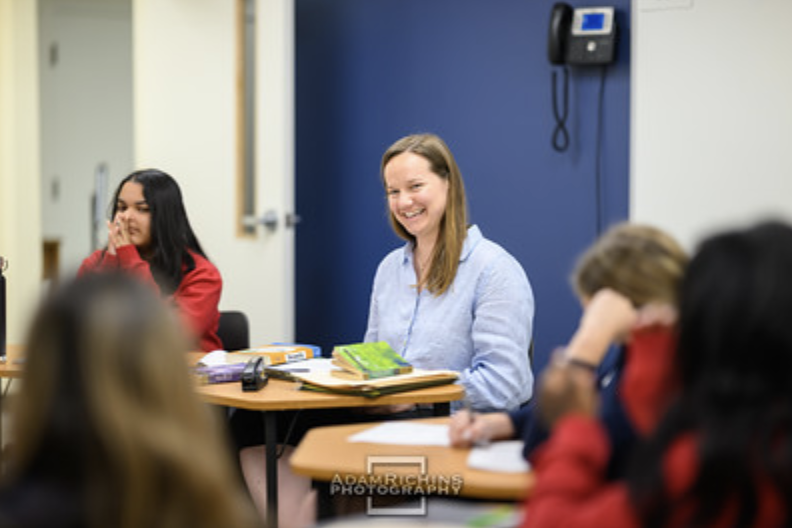
The words of Jack Nicklaus “that people only do their best at things they truly enjoy” apply readily to varied facets of life, and teaching is by no means an exception to this principle. After an interview with Montrose English teacher Ms. Spiering (selections of which are included below), the connection between excellence and passion in her own role became clear to me. Ms. Spiering has been teaching at Montrose for the last two years, as well as helping to lead the student cantoring program at mass. Her enjoyment and care for the work she does is evident in the classes she leads, as well as the extra help and discussions she has with students outside of the classroom. Our interview focused on her teaching style, goals, and the ways connections with literature affect students and their perspectives of the real world.
Elisabeth Smith: Why did you choose to teach literature?
Ms. Spiering: I majored in philosophy and psychology in college, and I discovered that my favorite things about philosophy and psychology were in literature. So it was more grounded and more true, like psychology can be a little bit funky at times.
ES: Why do you say that?
KS: So, it’s in its effort to be completely objective and scientific, it ends up abstracting out of some of the really important details about being human. It tries to quantify, and obviously there’s qualitative research and you can sort of do your best, but because it’s aggregate data it ends up taking some of those little details and shifting them to the side. And I think that those are often some of those important ones. And literature doesn’t do that. So literature isn’t an average. It’s not something that’s trying to quantify and distill in that same way. It’s got more of a… it speaks to a universal aspect of man that’s relevant to a lot of people, but it does so in a way that’s very much tied to specifics, a specific instance. So it’s not divorced from reality and it’s not abstract, it still has those little details that make it alive and real. I found psychology, much as it does help us—it gives us a lot of principles—it is also a little bit… sterile. Sort of like the way medicine can be, like if you use a lot of aggregate data versus like a nurse with the patient in front of her, you know, or him.
ES: So what’s the best lesson you’ve learned from teaching?
KS: I could give a couple. One of them… is something my sister taught me actually. In her work as a teacher, she taught me that it’s not about the teacher, it’s about the text. And, when it comes down to it, the real people that were teaching the class are the authors that we are reading. There can be a temptation as a teacher to to infuse the class with a lot of your own personality and make it like this kind of experience. And I don’t know that that’s necessarily a bad thing, especially if you have particularly bland material or stuff that’s not intrinsically interesting for people or if they find it non-intrinsically interesting, it can work as an additional aid. But the text is king, and that’s why it matters so much, what curriculum you have and what books you read. It’s because the true teachers are the ones on the written page.
ES: How, as a teacher, do you think you need to interact with the written page to make it come alive…?
KS: A small part of it, I think, it shifts a little… from elementary to middle to high school to college. In my experience for high school students… giving a few practical ways of how this applies in real life, that can aid. Because what motivates? It’s having a practical application in knowing that there’s something that you can learn from this that will help you better in your life, help you understand yourself better, live a better life, or be a better friend.
ES: So what, helping the students see the practical application?
KS: But also just modeling the delight of it, I think, and that’s, it’s a little funky because it’s… trying to show how something is enjoyable is a little bit odd. But if you’re like, ‘no, this is beautiful, this is good,’ so it is drawing the desire to a good, then, I don’t have to try super hard to make these goods desirable because they’re intrinsically desirable. So all I have to do, I view my role primarily as facilitating contact with the student with the text. Whenever that’s fallen short, I can sort of aid in a little bit of translation so that the text becomes more accessible or aid a little bit in the student’s ability to comprehend it. And then and then I can step out because the goal is for them to have that contact with the text, because then they will be able to have that for the rest of their lives.
ES: What’s the most important lesson you think you’ve taught?
KS: It is hard to say because you don’t often… I mean, teaching is such long game work. You know, it’s not the kind of thing where you have a class and then a student comes back and they’re like, ‘well, that one was the most important lesson of my life, it’s going to shape me for the rest of my life.’ Nobody says that because you don’t know what’s important until you’ve lived and you reflect back and you’re like, ‘oh, wait, that idea from that book shifted my life.’ So I can see in my own life where a text that I read in high school has shaped who I am today. But currently I’m operating on hope, you know, because I don’t yet have that evidence. I’m very young in teaching, so… I don’t get to see the fruits of my labors yet, but it’s like farming. You plant it, it’s going to take a long time for it to grow fruit and that’s okay. So I have a lot of faith in what I’m doing because I’m emulating people who I have seen bear fruit. I’m seeing, if I do the right, the same things and I try to do it in a similar way, I think that it will have a similar effect.
In my year with Ms. Spiering as a British Literature teacher, one thing has become abundantly clear to me: that beauty comes from dedication to and enthusiasm for the work one does, and not merely quantifiable ‘success’ at it. When watching her lead a discussion or introduce a writing assignment in class, the joy and fulfillment she derives and shares from her own search for wisdom is enjoyable just to witness.
Due to this introduction to the “delight” of the books I have read for school, they have become a source of connection with people I have met outside of school, connections I would have missed out on otherwise. It was Ms. Spiering’s passion that ignited much of mine through the chance to have interests supported and encouraged so much of my personal intellectual development, along with my classmates whose own interests I have seen come alive this year. Because of the class, I have rediscovered the wealth of treasures that literature holds (much of which is still unexplored) and its relevance for my real life, in spite of its fictionality.
So, it is with gratitude that I share the greatest lesson I have learned this year, in the words that Ms. Spiering shared with me of St. Thomas Aquinas: “in so far as a man gives himself to the pursuit of wisdom, so far does he even now have some share in true beatitude.”
By: Elisabeth Smith ‘28, Co-Editor-in-Chief
28esmith@montroseschool.org